
The mounting structure is the least glamorous part of a solar plant — and the one that decides whether your modules are still perfectly aligned in year 15. Here is how we advise customers to choose, based on what our teams see on real sites.
Start with the roof (or the land), not the catalogue
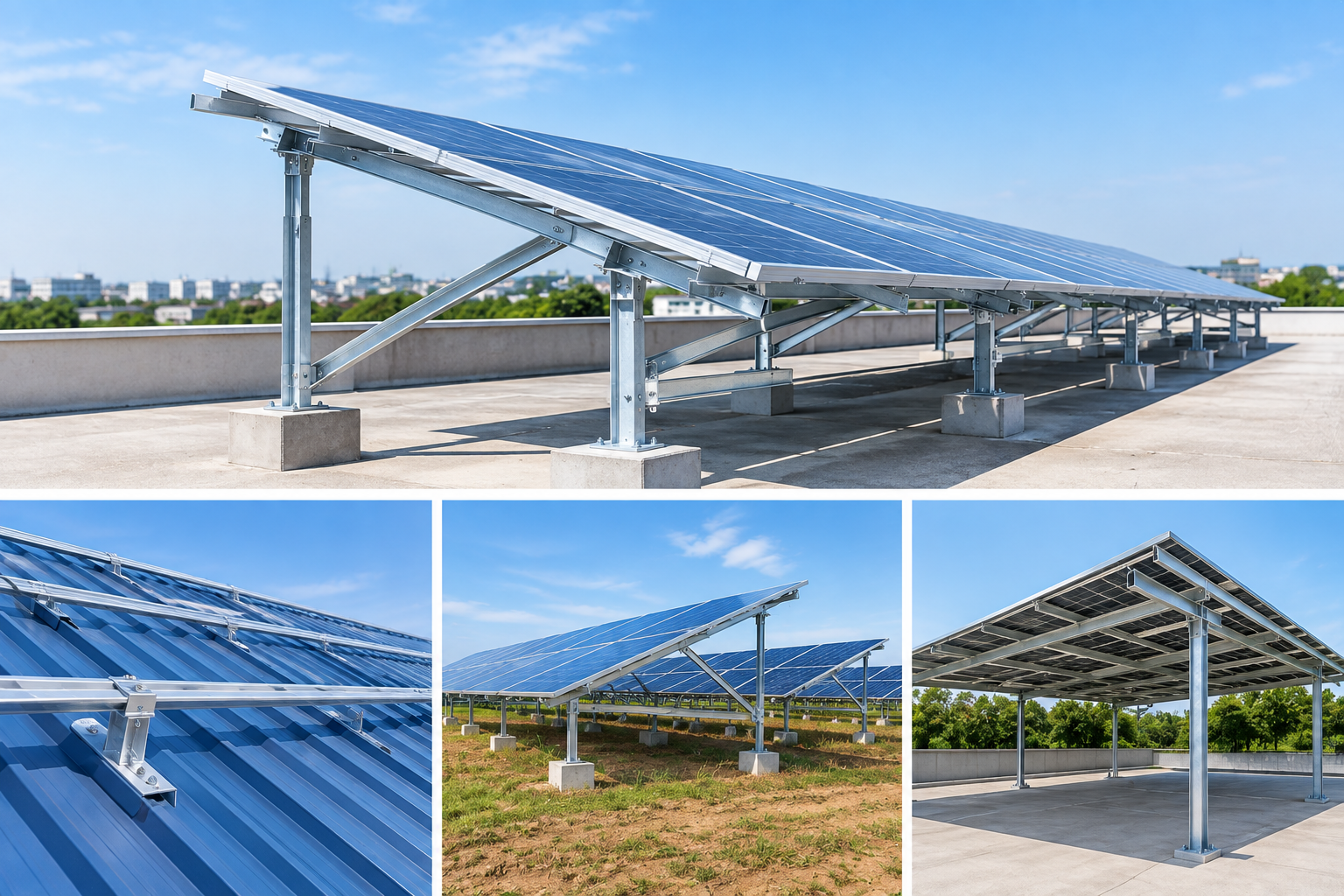
Every structure decision flows from the site. A flat RCC roof, a sloped industrial tin shed and open land need completely different systems:
- RCC rooftop — low-rise structures keep wind load and cost down; elevated (walkway-height) structures preserve roof usability and ease cleaning.
- Tin shed / purlin — clamp-and-bracket systems that fix to the purlins without puncturing the sheet more than necessary. Sheet condition and purlin spacing decide everything here.
- Ground mount — fixed-tilt tables sized to soil conditions; foundation choice (pile, screw, ballast) matters more than the table design.
- Carport — a structure and a building at once; drainage and clearance heights need real engineering, not a scaled-up rooftop design.
The three specification lines that matter most
- Wind-load design. India’s wind zones vary from 33 m/s to 55 m/s basic wind speed (IS 875 Part 3). A structure designed for Surat may be undersized for coastal Gujarat. Ask for the design wind speed in writing.
- Material and coating. Hot-dip galvanization per IS 4759 / ISO 1461 with adequate coating thickness is what stands between your structure and rust. “GI” on a quotation can mean many things — ask for microns.
- Module compatibility. Large-format modules (2.2 m+, 550–700 Wp) load rails differently than the 60-cell modules older designs assumed. Confirm the structure is engineered for the module you are actually buying.
Red flags we see in the market
- Quotations with no steel grade, no coating specification and no design basis — just a price per kW.
- Structures that arrive with wrong or missing punching, forcing site drilling that destroys the coating.
- Mixed fastener quality — a hot-dip structure assembled with plain MS bolts rusts from the joints outward.
Ask for it in writing
- Design wind speed — India’s zones run 33 to 55 m/s basic wind speed (IS 875 Part 3). A structure designed for Surat may be undersized for coastal Gujarat.
- Coating thickness in microns — hot-dip galvanization per IS 4759 / ISO 1461. “GI” on a quotation can mean many things.
- The module it is engineered for — large-format modules (2.2 m+, 550–700 Wp) load rails differently than the 60-cell modules older designs assumed.
Walk away if you see
- No design basis — no steel grade, no coating specification, just a price per kW.
- Wrong or missing punching — it forces site drilling, and site drilling destroys the coating.
- Mixed fastener quality — a hot-dip structure assembled with plain MS bolts rusts from the joints outward.
Our rule: the structure should be the part of the plant you never think about again. If you’d like a site-specific recommendation, send us your roof photos or land dimensions — our engineers will respond with a workable design and price.