
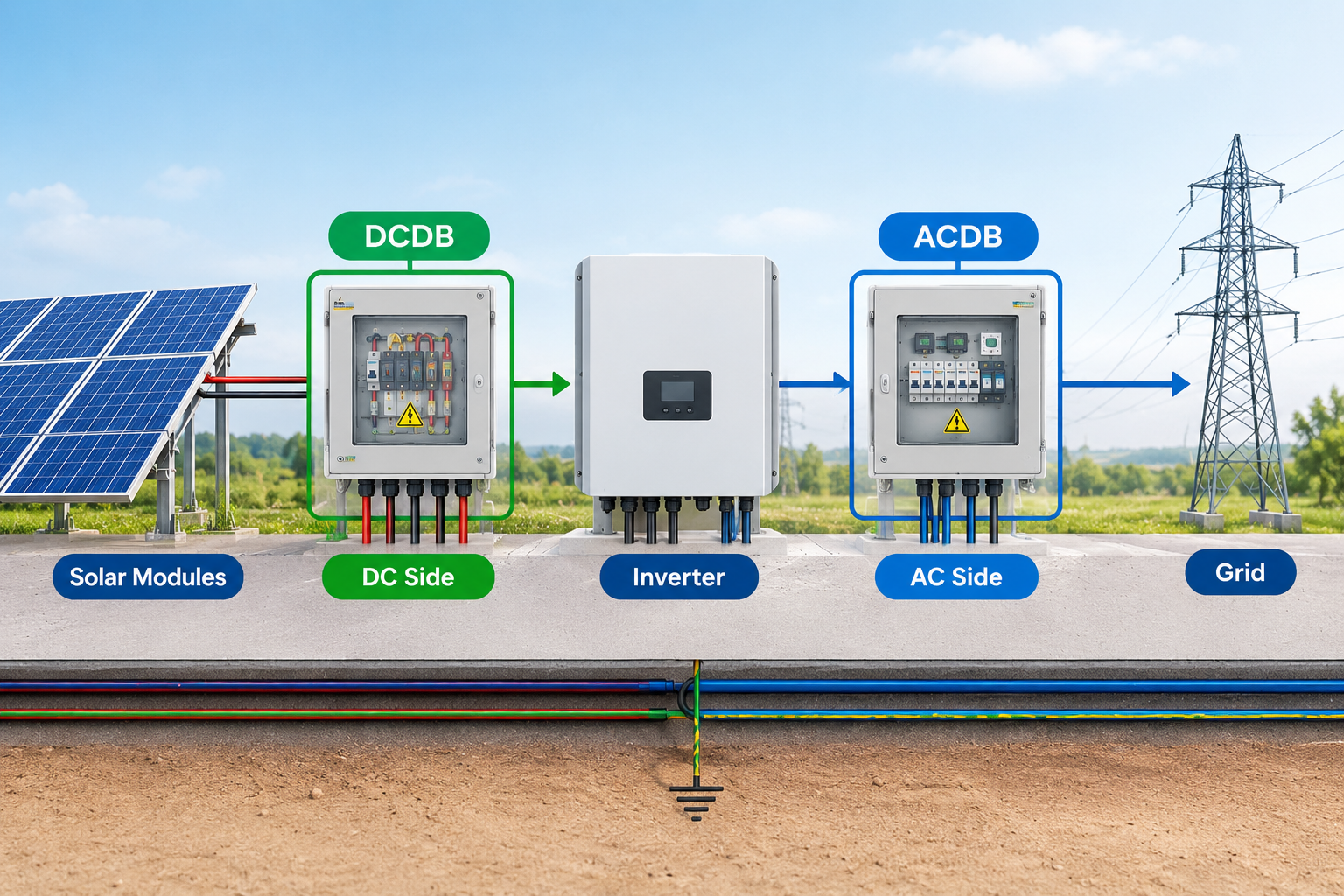
Every grid-connected solar plant has two distribution boards that outsiders mix up constantly: the DCDB between your modules and the inverter, and the ACDB between the inverter and the grid. They do different jobs, face different risks, and are specified differently. Here’s the plain-language version.
Solar modules
Strings coming off the array
DCDB
- gPV string fuses where the array needs them
- DC surge protection
- DC load-break isolator, rated for the array voltage
Inverter
DC becomes AC here
ACDB
- MCB or MCCB
- AC surge protection
- Metering and indication
- AC isolator for the DISCOM
Grid
Your net-metering point
Earthing and bonding per IS 3043 runs under all of it — it is where both SPDs send the surge, and where the module frames and the mounting structure connect.
DCDB — protecting the DC side
The DC distribution board (also called a string combiner box) sits between your solar strings and the inverter. Its job is to combine string outputs safely and protect against faults on the DC side, where current doesn’t cross zero and arcs don’t self-extinguish — which is why DC protection is specified more conservatively.
- gPV fuses on each string — the “gPV” class is designed for photovoltaic DC, ordinary fuses are not.
- DC surge protection (SPD) — lightning-induced surges enter through the array; the DC SPD clamps them before the inverter.
- DC isolator — a load-break switch rated for the system’s DC voltage (1000 V or 1500 V), so the inverter can be worked on safely.
ACDB — protecting the AC side
The AC distribution board sits between the inverter output and your grid connection point. It protects the cable and switchgear downstream of the inverter and gives the DISCOM a clean interface:
- MCB or MCCB sized to the inverter’s output current — the main overcurrent protection.
- AC surge protection (SPD) — surges also arrive from the grid side; Type II is the common choice, Type I+II where lightning exposure is high.
- Metering and indication — energy meters, voltmeters and lamps as your net-metering arrangement requires.
- AC isolator — a lockable, visible-break switch at the grid interface. Most DISCOMs require one they can reach and lock open themselves.
What decides the quality of a panel
Two panels with identical component lists can behave very differently after five monsoons. The difference is build quality: an enclosure with a genuine IP65 rating and gasketed door, wiring that is ferruled and labelled so a technician can trace a fault in minutes, glands fitted properly so the rating survives installation, and — most tellingly — a test report (continuity, insulation resistance, functional checks) that shipped with the panel.
That last item is our standard practice: every ACDB, DCDB and LT panel we assemble leaves the factory with its own test report. If you’re specifying panels for a project, share your single-line diagram and we’ll quote exactly what your design needs — or draft the SLD with you if it doesn’t exist yet.